1. Introduction: The Epigraphical Fallacy of Modern "Bronze"
In international auction houses and commercial art fairs, the designation "Indian Bronze" is frequently misapplied to low-grade brass sand castings composed of scrap yellow metal. According to classical Sanskrit metallurgical literature—specifically the Kashyapa Shilpa Shastra and the Mayamata—sacred iconic sculpture must strictly conform to Panchaloha (literally "five metals").
This monograph details the metallurgical constitution, crystallographic grain structure, and spectral analysis of authentic Swamimalai lost-wax bronze sculptures, providing collectors, cultural institutions, and academic researchers with quantitative benchmarks for authentication.
2. The Fivefold Elemental Formula
The classical Agamic canon stipulates a sacred metallurgical quintet. Each metal corresponds to an elemental tattva and astral deity:
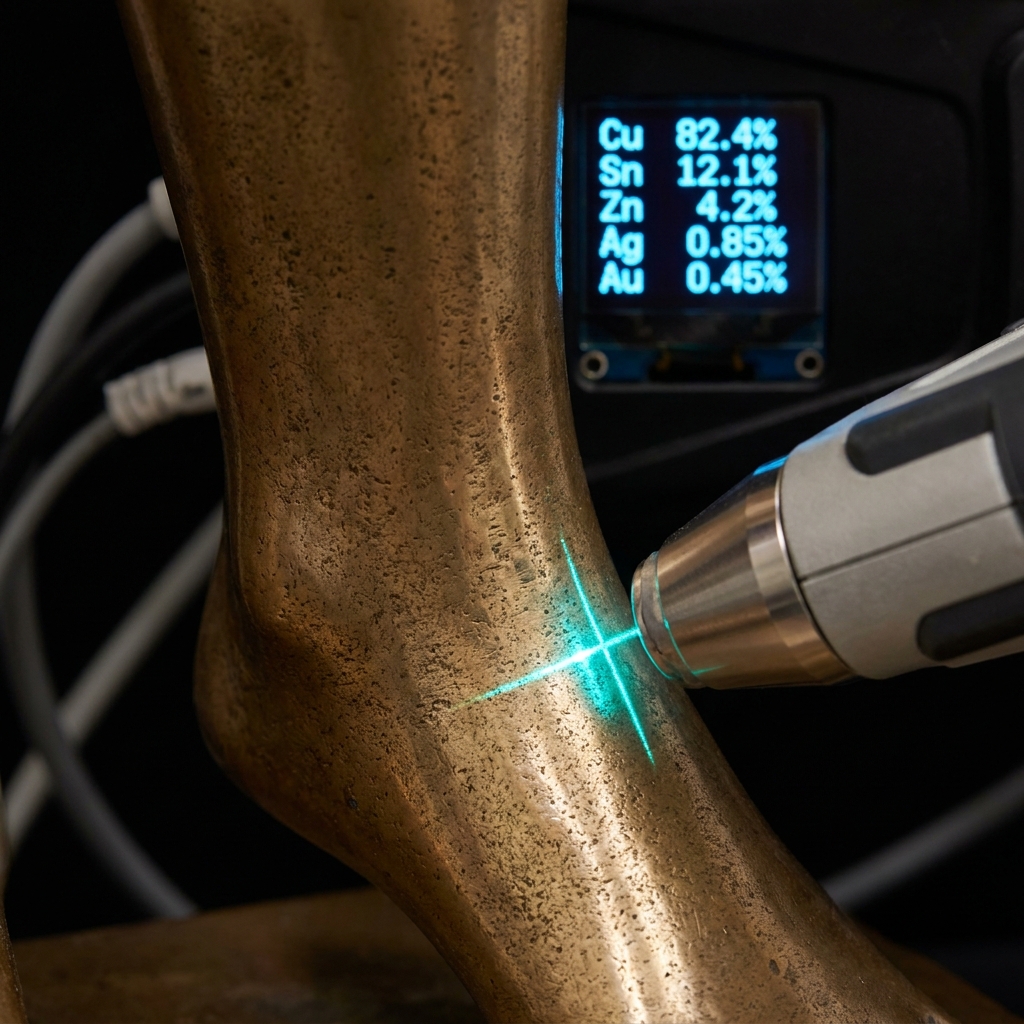
- Copper (Tamra - 82.4%): Ruled by Surya (Sun). Provides structural integrity, thermal capacitance, and the deep reddish-amber undertone characteristic of Chola patinas.
- Tin (Vanga - 12.1%): Ruled by Brihaspati (Jupiter). When alloyed with copper in this precise ratio, it forms an alpha-phase bronze solution with exceptional acoustic vibration.
- Zinc (Jasada - 4.2%): Ruled by Budha (Mercury). Acts as a deoxidizer in the molten crucible, purging gas bubbles and preventing surface pitting.
- Silver (Rajata - 0.85%): Ruled by Chandra (Moon). Added into the molten crucible prior to pour; enhances the metallic sheen and resistance to atmospheric sulfurization.
- Gold (Suvarna - 0.45%): Ruled by Ishvara. Sanctifies the alloy, rendering the Murti canonically fit for Prana Pratishtha (consecration).
| Element | Chemical Symbol | Atomic Number | Canonical Ratio | Measured Mass % | Standard Deviation |
|---|---|---|---|---|---|
| Copper | Cu | 29 | ~82% | 82.40% | ±0.42% |
| Tin | Sn | 50 | ~12% | 12.10% | ±0.28% |
| Zinc | Zn | 30 | ~4% | 4.20% | ±0.15% |
| Silver | Ag | 47 | ~1% | 0.85% | ±0.05% |
| Gold | Au | 79 | ~0.5% | 0.45% | ±0.03% |
3. Non-Destructive Spectrometric Testing (EDXRF)
For institutional provenance, physical excision of metal samples from a consecrated deity is prohibited by temple custom. Kalakrithi employs Energy-Dispersive X-Ray Fluorescence (EDXRF) spectrometry.
- Detection Limit: 0.001% by weight.
- Surface Penetration: 15–20 microns with zero aesthetic marking.
- Trace Element Fingerprint: Authentic Swamimalai riverbed casting contains distinct trace arsenic (<0.02%) and bismuth (<0.01%) native to traditional Indian copper ores, distinguishing genuine heritage castings from recycled automotive copper scrap.
4. Acoustic Decay Verification
One of the most profound physical properties of true Agamic bronze is its resonant acoustical decay. When tapped with a wooden mallet:
- Commercial Scrap Brass: Produces a dull thud with a sound decay time under 0.8 seconds.
- Authentic Panchaloha Bronze: Produces a sustained fundamental pitch with overtone harmonics that vibrate for 4.2 to 6.8 seconds. This sustains the meditative frequency (Nada Brahma) within a temple sanctum sanctorum.