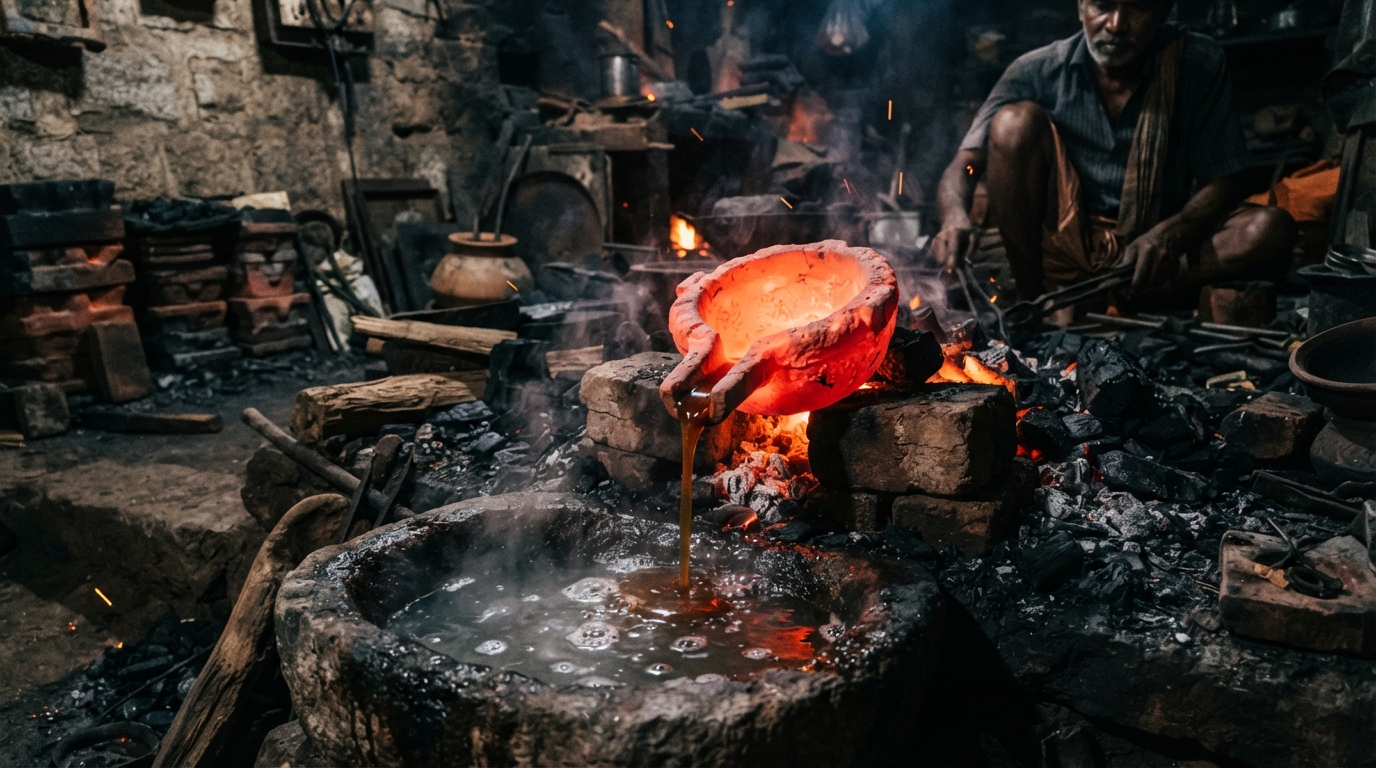
1. The Lost-Wax Lineage: Queen Sembiyan Mahadevi's Legacy
The 10th and 11th centuries under the imperial Cholas represented the pinnacle of world bronze metallurgy. Queen Sembiyan Mahadevi, widowed in 957 CE, dedicated four decades of state patronage to codifying the lost-wax (Madhuchchhishta Vidhana) bronze foundry schools along the banks of the Kaveri River.
Unlike European Renaissance hollow bronzes that utilized interior iron armatures, traditional Chola process produces solid castings. The entire volume from core to surface is solid, dense, crystalline Panchaloha.
2. The Wax Matrix (Mezhugu Model)
The creation begins not with clay or digital CAD, but with a warm, pliable botanical wax formulation:
- Pure Beehive Wax (Then Mezhugu): 70% by weight.
- Dammar Gum Resin (Kungilium): 25% by weight. Imparts tensile hardness so sharp facial features do not slump in tropical heat.
- Wild Sesame Oil (Nallennai): 5% by weight. Imparts plasticity and elongation during sculpting.
Every finger, jatamukuta strand, flame ring (Prabhavali), and the crushed dwarf of ignorance (Apasmara Purusha) is sculpted entirely by hand using heated coconut-shell spatulas.
3. The Threefold Kaveri Silt Refractory Mould
The wax sculpture is coated in three successive layers of alluvium from the sacred Kaveri River:
- The First Coat (Karuvai): Ultra-fine silt gathered from river sediment, ground with charred rice husk. This captures microscopic fingerprints and eye pupil details.
- The Second Coat (Edai Mannu): Clay mixed with river sand to provide structural mass.
- The Third Coat (Kaluval): Coarse red earth reinforced with jute fibers, baked in an open wood and cow-dung fire kiln.
When the mold is fired to 400°C, the wax melts and drains out completely—hence the term lost-wax. The mold is now an inverted, empty terracotta chamber awaiting the molten bronze.